
A weighted walk.
Markov Chain Monte Carlo provides a random-walk foundation for selecting vertices through the graph.
A visual journey through VINE, the directed acyclic graph at the heart of Grape.
Based on VINE technical paper v.02

VINE groups transactions into entities called sites. Each new site links to two earlier sites, building a directed graph of direct and indirect confirmations.
A parallel sequence of commit transactions coordinates the evolving graph into shared ledger state.
VINE technical paper · p. 9Swipe across the graph to explore its connections ↔
Follow a transaction through the architecture. Each stage does a specific job, from a client’s signature to the network’s coordinated ledger view.
VINE technical paper · p. 11
A client creates and signs a transaction, then sends it to a network node.
Select a stage or play the journey
VINE describes a family of selection algorithms that choose earlier sites to reference. The objective: grow the graph while managing confirmation and consistency.
Markov Chain Monte Carlo provides a random-walk foundation for selecting vertices through the graph.
A VINE adaptation of the selection process, described in the paper’s algorithm sequence.
Extends site weighting with factors such as node ratings and commissions in the paper’s proposed model.
Commits organize verified sites, account balances and smart-contract results into a consistent reference point.
The paper describes a roughly five-second commit cadence. This is a document-era design parameter, not a current finality guarantee.
VINE technical paper · p. 20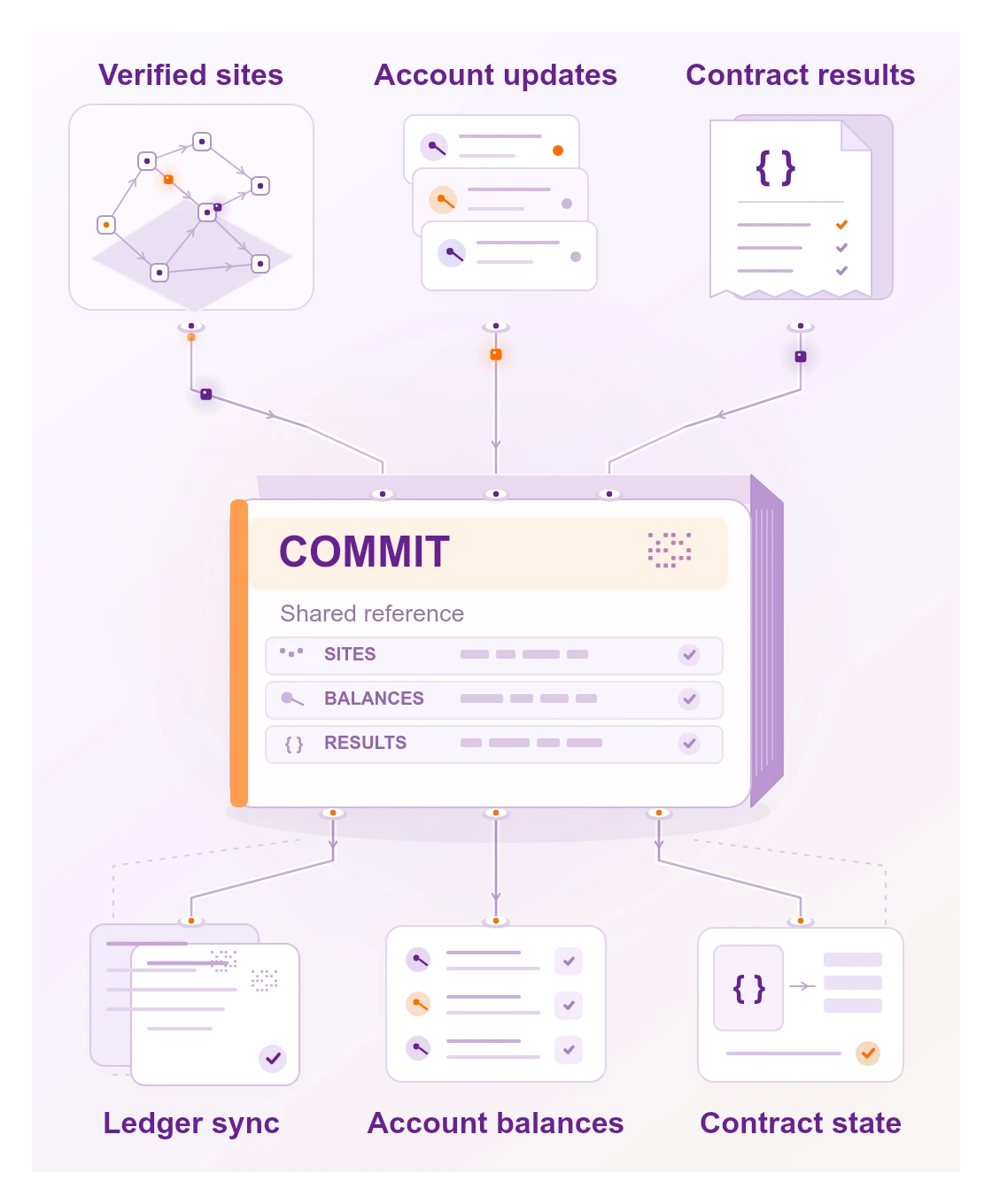
Smart contracts use the ledger state published in commits. Changes in intervening sites become available through the next coordinated state update.
A transaction deploys a contract or invokes an existing one.
Contract transactions pass through the verification process.
Execution produces results, receipts and state changes.
Commit data makes the resulting state available consistently.
Grape’s current product direction brings EVM compatibility to this DAG foundation. The older VINE paper describes smart-contract processing; it does not define the current EVM integration, RPC endpoints or supported tooling versions.
Every node keeps its own view of the network. See how a shared starting point, connected graph records and peer-to-peer updates bring those views together.
VINE technical paper · p. 21Swipe to explore · Arrow keys when focused
A shared starting point.
A new node receives a recent commit reference: a coordinated view of ledger state. Related records follow, giving the node a foundation while synchronization continues.
In the paper’s implementation, a leader provides the initial commit.
Swipe to explore · Arrow keys when focused
Fill the gaps. Connect the records.
A node requests missing sites, including earlier records referenced by a newly received site. Structure and signature checks help it connect valid records to its local graph.
This brings relevant sites not yet included in a commit into the local view.
Swipe to explore · Arrow keys when focused
An update becomes shared knowledge.
Nodes pass new sites, contract transactions and commit references to connected peers. Those peers check and relay the updates, carrying information across the network.
The paper describes gossip communication based on a modification of HyParView.
Swipe to explore · Arrow keys when focused
More history. A considered path forward.
The paper proposes organizing fully verified history into slices to reduce repeated verification. It also identifies sharding as a direction for dividing future workloads.
Development concepts: slicing was not implemented at the paper’s publication stage.
Different records do different jobs. Explore how a transaction becomes a site, how commits organize state, and what execution leaves behind.
Data formats · p. 24Swipe to explore · Arrow keys when focused
A transaction becomes a connected graph record.
A site carries a transaction with its identifier, timestamp and verification-related data. It references two earlier sites, connecting its activity to the wider DAG.
Those connections support direct and indirect graph confirmation.
Swipe to explore · Arrow keys when focused
Parallel activity. An ordered ledger reference.
A commit gathers site references, included site records, balances and contract-execution data. Each commit links to its predecessor in a separate sequence alongside the transaction DAG.
Contract receipts and state differences occupy distinct parts of the record.
Swipe to explore · Arrow keys when focused
An account is a defined set of state fields.
The paper lists an address, balance, nonce, code hash and code. An account update carries a new account value; the commit’s balance map connects wallet identifiers with balances.
Account fields follow the format documented in Appendix A.
Swipe to explore · Arrow keys when focused
What happened. What changed.
A receipt reports success or failure, execution fuel used, a status message and logs. State differences separately describe either a storage update or a new account value, and travel with the commit.
Execution results and state changes are related records with different responsibilities.
Swipe to explore · Arrow keys when focused
Seen, referenced and accepted mean different things.
Propagation spreads an update to peers. Graph confirmation reflects sites that reference it directly or indirectly. Commit acceptance depends on the implemented verification and consensus rules; speed alone does not establish irreversible finality.
The paper states that validator consensus acceptance of commits was not implemented at its publication stage.
VINE technical paper v.02 · 27 pages · PDF
This visual guide explains the supplied VINE paper. It is an architecture reference, not certification of current mainnet behavior. The paper notes that validator acceptance of commits and slicing were not implemented at its publication stage, and its smart-contract flow used a leader implementation. Current benchmarks, deployed consensus, audit reports and operational parameters require separate release evidence.